Screen Printing in Nepal: How It Works, Best Uses and Limits
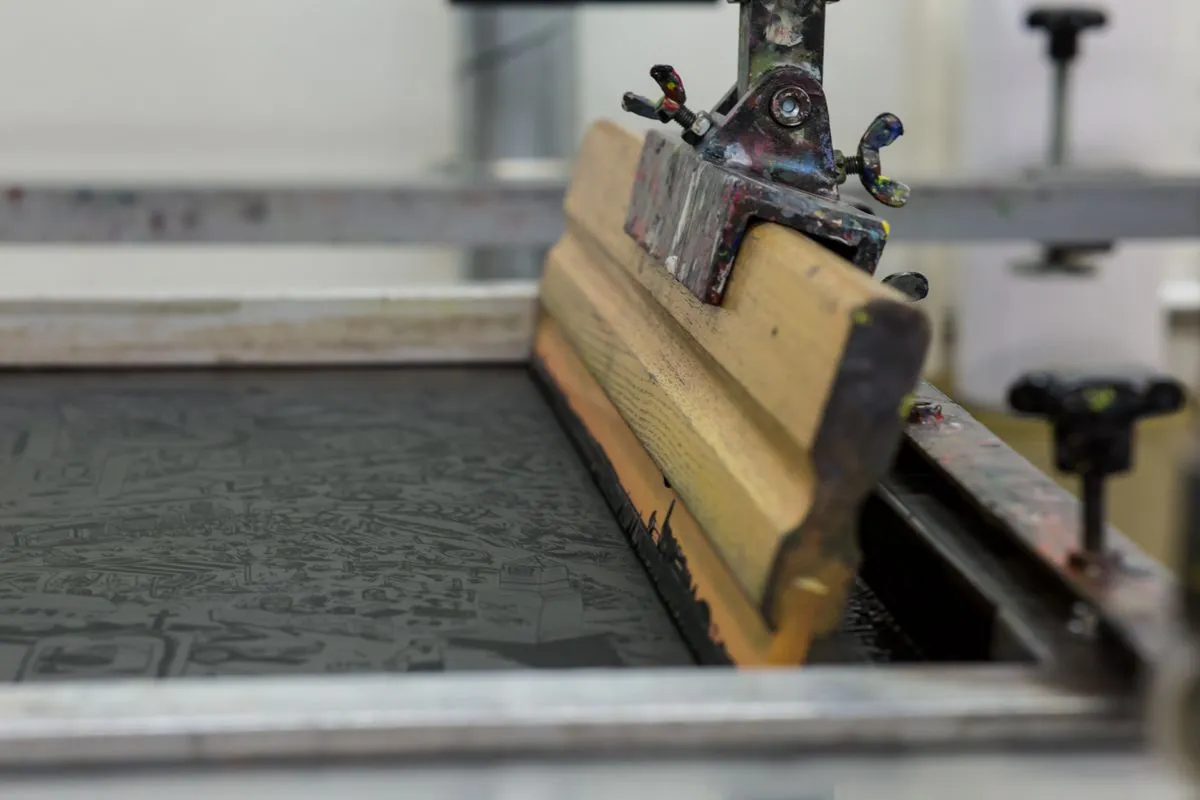
Quick answer: Screen printing pushes ink through a mesh screen that carries a stencil of your design, one colour at a time. It lays down thick, bright, durable ink, which is why it is used for T-shirts, tote bags, signs, bottles and promotional goods. Each colour needs its own screen, so it is best for designs with few flat colours and for runs large enough to spread the setup cost.
Screen printing is among the most searched printing terms in Nepal, with "screen printing", "t shirt printing" and "screen printing machine" all in the Google Trends top queries. This guide explains the process, what to expect and when another method is better.
How screen printing works
- Design and separation. The artwork is split into colours. Each colour becomes a black film positive.
- Screen coating. A mesh stretched on a frame is coated with light-sensitive emulsion and dried.
- Exposure. The film is placed on the screen and exposed to light. The emulsion hardens except where the design blocks the light.
- Washout. The unhardened emulsion is washed away, leaving an open stencil of the design in the mesh.
- Printing. The screen is placed over the item. Ink is pushed through the open areas with a squeegee onto the surface. One screen per colour, in order.
- Curing. On fabric, the ink is heat-cured so it will survive washing.
Video: Screen Printing T-Shirts From Start To Finish, by Baav Productions (third-party demonstration)
What screen printing prints best
| Item | Why screen works |
|---|---|
| Cotton T-shirts and uniforms | Thick ink bonds well and lasts |
| Tote bags and cloth bags | Bold logos on fabric |
| Signs, boards and posters | Strong flat colour |
| Bottles, mugs and promotional goods | Ink prints on curved or hard surfaces with the right setup |
| Packaging such as bags and some boxes | Flat colour logos |
What it does less well
- Photographs and gradients. Fine photographic detail is difficult with many screens. Use CMYK processes for photos.
- Very short runs with many colours. Each colour adds a screen, and screens take time to make.
- Fine detail on rough surfaces. Mesh and ink limit detail.
Why each colour adds cost
Every colour needs its own screen, its own exposure and its own pass. A two-colour logo needs two screens; a five-colour design needs five. That is the main reason screen printing is quoted by number of colours and by quantity. Ask for the price at two quantities, because setup is a fixed cost.
Screen printing, DTF and sublimation
| Screen | DTF | Sublimation | |
|---|---|---|---|
| Colours | Few flat colours are cheapest | Full colour and photos | Full colour and photos |
| Setup | Screens for each colour | None per design | None per design |
| Best quantity | Medium to large | Small to medium | Small to medium |
| Fabric | Cotton, blends | Cotton, polyester, blends | Polyester and light colours |
| Handfeel | Ink layer on the fabric | Soft film layer | Dye in the fibre, no feel |
See T-shirt printing methods and DTF printing explained.
Preparing artwork for screen printing
- Supply vector artwork (logo as vector, not a small image) where possible.
- Use flat colours and name them as Pantone references if exact matching matters.
- Keep fine lines thick enough to hold in the mesh.
- State the garment colour, because a light ink on a dark shirt needs a white underlay.
- Approve a proof or a sample print before the full run.
See artwork file prep and CMYK vs Pantone.
Brief for a screen printing quote
- Item and material (fabric type and colour, or surface)
- Print size and position
- Number of colours
- Quantity, with a second quantity to compare
- Artwork format and proof requirement
- Delivery date and place
Frequently asked questions
Is screen printing better than DTF?
Not always. Screen printing is cost-effective for larger runs of simple designs. DTF is easier for full-colour designs in small quantities.
Does a screen printed design wash off?
Properly cured ink is designed to last through washing. Ask about cure and wash testing.
Can screen printing do photos?
It can with halftone or many screens, but results and cost are usually better with DTF or digital methods.
What is the minimum quantity?
It varies by shop and by the number of colours. Ask for the minimum and the price at two quantities.
Related Thankyooou pages
For packaging and bag printing see the product catalogue and paper bag prices, or contact Thankyooou to ask whether your project is available.
Sources
- Screen printing — Britannica — mesh stencil process.
- Google Trends, Nepal, "printing", exported 11 November 2026 — screen printing and t shirt printing among top related queries.